
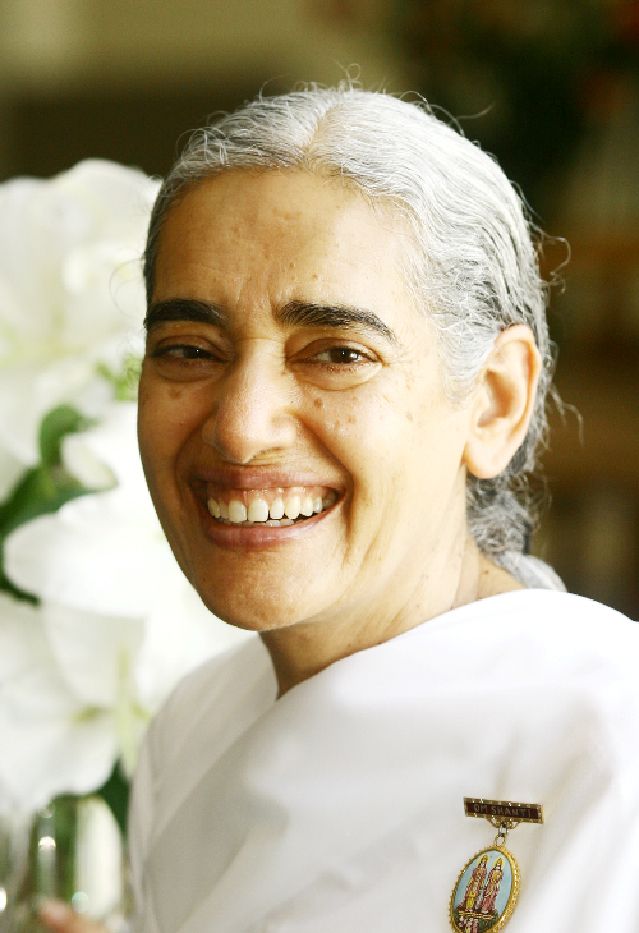
Sister Jayanti, Additional Administrative Head of the Brahma Kumaris
Sr. Jayanti:
One of the definitions of freedom that I particularly appreciate is the one Dadi Janki once gave: “Freedom is being able to do everything that I know I should do without anything preventing me from doing it, and also not being forced to do something that I should not do.”
When I first heard this, it took me some time to absorb it. Then I understood what she meant and realized that it referred as much to what is within us as to any external obstacles.
Sometimes I know what I would like to do, but I lack the courage, faith, or determination to take action. I am then held back by my own limitations. But there are also times when I tell myself: “I know I should do it, but I don’t know what others will think!” I then feel hindered in my actions or in my personal progress by my own weaknesses and by the external pressures that I experience, or believe I experience. At that moment, I am caught in bonds, and freedom consists precisely in being beyond those bonds.
The second part of this definition concerns those moments when I tell myself that I do not really wish to do something, yet I do it anyway for one reason or another. Or when I did not want to do it, but my emotions were so strong that I could not help myself. By creating these kinds of bonds, both internal and external, we trap ourselves in artificial situations. Freedom is being able to manage all these bonds.
A Beautiful Definition of Forgiveness
For several years now, my efforts have been directed toward learning how to forgive and also how to forget the mistakes of others, but even more than that, to erase them deeply from my consciousness so that the person concerned can also forget their mistake. My consciousness must become powerful enough for me to be able to help the other person move beyond and forget their past mistakes.
Otherwise, we know what generally happens: every time that person finds themselves in my presence, the weight of their mistake and their own guilt spoil our relationship. But if my heart is generous enough to have forgiven and forgotten, and if I also help them to forget, then we can rebuild a relationship on new foundations.
True forgiveness is when we no longer remember the mistake and when we help the other person to forget it as well.
Benefits for the One Who Forgives
It is very unhealthy for the mind to hold on to bitter feelings in the heart. This casts a shadow over everything we do and clouds our power of discernment to the point that the inner being, the soul, becomes unwell.
Many studies have been conducted on the psychosomatic effects of the mind on the body. Any bitter feeling frozen in the mind or heart also poisons our physical condition.
To be free, I must move forward, let go, and not remain stuck. A lack of forgiveness keeps me attached to past situations, preventing me from doing what I need to do at the right time.
What emerged from the recent demonstrations in the suburbs of London was compassion. This clearly illustrates that the true nature of the human soul is goodness and kindness, not violence or aggression.
As soon as people are shown respect, their self-esteem grows and their response changes. These are the feelings that must be nurtured, even if it takes time. When addressing entire communities, respect and dignity are fundamental values that are often absent from their daily lives.
From a spiritual perspective, if we forget the inner being and focus only on appearances, we will naturally see differences and comparisons in terms of size, colour, or social status. But as soon as I focus on the spiritual entity, I discover my inner values and there is no longer any question of competition, because I know who I am. Being aware of my own worth, I can respect myself and respect others.
Two figures of the twentieth century changed the course of history simply through their capacity to forgive: Nelson Mandela and Mahatma Gandhi. Gandhi was once asked, “What do you do in the face of your enemies?” He replied, “I do not regard anyone as my enemy. I see everyone as my friends.”
Question from the Audience:
How can we cultivate thoughts of forgiveness and freedom in the face of financial pressure and austerity, which are affecting an increasing number of people around the world?
Sr. Jayanti:
Questions relating to the instability of financial institutions and to corruption arise more and more frequently. All of this highlights the limitations of a consumer society that believed growth would continue indefinitely and is now realizing that it is exhausting the planet’s resources.
Our outlook has become highly materialistic and self-centred. We constantly want to acquire more, but the problem is that the more we have, the more we want. Souls never feel satisfied; they never experience contentment.
Only through spirituality and meditation can I find inner contentment and joy. If I remain connected to that inner contentment, my way of life can become much simpler, and I discover something far more beautiful and precious than anything I possessed before.